Table of Contents
- The NOL Card: The Key to All Dubai Public Transport
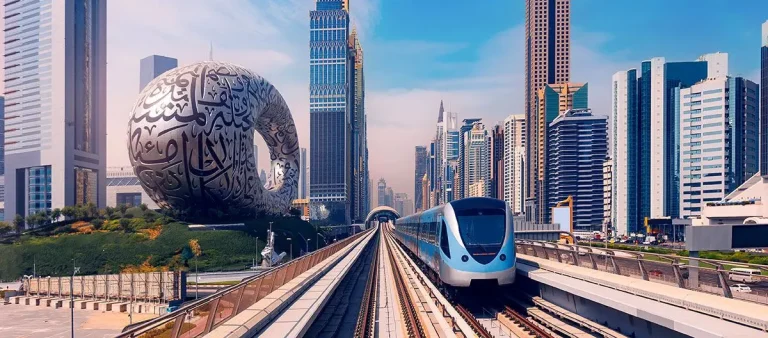
- Mode 1: Dubai Metro
- Mode 2: Dubai Tram
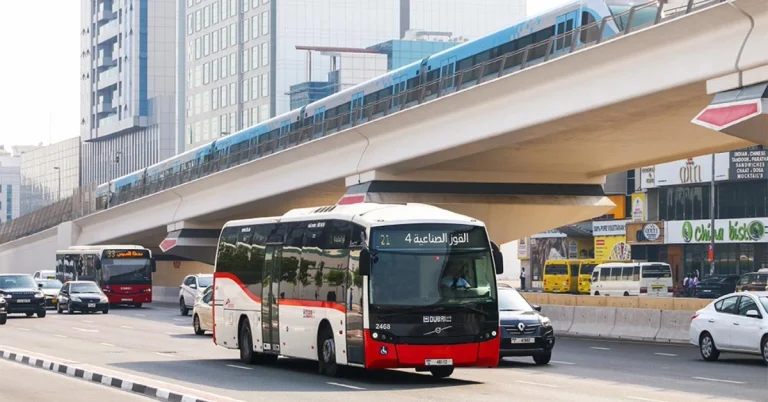
- Mode 3: RTA Fixed Bus Network
- Mode 4: Bus on Demand
- Mode 5: Taxis and Ride-Hailing
- Mode 6: Marine Transport
- Mode 7: Palm Monorail
- Dubai Public Transport by Destination: Practical Routing Guide
- Apps and Digital Tools
- Dubai Public Transport vs. Owning a Car: The Real Cost Comparison
- What's Coming: Dubai Public Transport 2026–2030
Dubai public transport is operated by the Roads and Transport Authority (RTA) and covers seven integrated modes: the Dubai Metro (Red and Green Lines, 64 stations), Dubai Tram (11 stations), RTA fixed bus network (1,518 buses, 119 routes), Bus on Demand (13 zones, app-only), taxis and ride-hailing, marine transport (abras, water taxis, ferries), and the Palm Monorail. Everything except taxis runs on the NOL card. Daily cap for Silver NOL: AED 14 across all modes. The RTA’s 2030 target is 90% of Dubai’s population within walking distance of a public transport station.
Dubai built itself around the car. Wide highways, abundant parking, a climate that discourages outdoor walking eight months of the year — the city’s physical design was never optimised for walking to a bus stop. Yet Dubai’s public transport system is now genuinely world-class, and for residents who plan their journeys intelligently, it eliminates the need for a private vehicle for the majority of daily trips.
The shift is measurable. The Dubai Metro recorded 143.9 million passenger journeys in the first half of 2025 — approximately 790,000 trips per day. The bus network carries 369,000 passengers daily. The system is unified, integrated, cashless, and expanding: the Dubai Metro Blue Line opens in September 2029, adding 14 new stations across eastern and northeastern Dubai communities that currently have no metro access at all.
This guide covers every mode of Dubai public transport in 2026 — how each works, what it costs, which areas it reaches, and how to combine them intelligently for daily commuting.
The NOL Card: The Key to All Dubai Public Transport
Before any mode is useful, you need a NOL card. Almost everything in the RTA network — Metro, Tram, Bus, most marine services and even some parking — uses one cashless NOL card system. Without one, you cannot board a metro, tram, or bus.
The NOL card (the word means “fare” in Arabic) is a contactless smart card issued by the RTA. There are four types:
| Card Type | Cost | Best For | Features |
| Silver NOL | AED 25 (AED 19 credit) | Daily commuters | All RTA modes, AED 14 daily cap |
| Gold NOL | AED 25 (AED 19 credit) | Gold Class metro users | Gold Class carriages, AED 40 daily cap |
| Blue NOL (Tourist) | AED 35 (AED 10 credit + 5 days unlimited) | Short-stay visitors | Unlimited metro/bus/tram for 5 days |
| Red Ticket | From AED 2 | Occasional users | Single or 10-trip ticket, no daily cap |
The AED 14 daily cap is the most financially significant feature for regular commuters. Once you spend AED 14 on any combination of metro, tram, and bus trips in a single day, all subsequent RTA journeys are free until midnight. This makes unlimited daily travel effectively cost AED 14 — about USD 3.80. For a resident who commutes twice daily on the metro, the cap is typically hit within 2–3 trips.
Zones determine fare. Dubai is divided into 7 transport zones. Most urban journeys cover 2–3 zones. Metro fares: AED 3 (1 zone) to AED 7.50 (3+ zones) for Silver Class. See our complete NOL card guide for all fare tables, top-up methods, and the full daily cap breakdown.
Mode 1: Dubai Metro
The Dubai Metro is the backbone of Dubai public transport — a fully automated, driverless, air-conditioned rapid transit system that is the fastest and most reliable way to travel across the city.
Key facts:
- Lines: Red Line and Green Line
- Stations: 64 total (53 Red Line, 47 Green Line, with 6 shared interchange stations)
- Track length: Approximately 90 km total
- Operating hours: Saturday–Thursday 5:30 AM–midnight; Friday 10:00 AM–midnight; extended for major events
- Frequency: 3–7 minutes during peak hours; 7–10 minutes off-peak
- Fare: AED 3–7.50 (Silver Class); AED 6–15 (Gold Class)
Red Line: The City Spine
The Red Line is the backbone of the Dubai Metro, running from Centrepoint Station in Rashidiya all the way to Expo City in the south. It passes through the city’s primary commercial corridor — Dubai International Airport (Terminals 1 and 3), Deira, Bur Dubai, Union, the financial district, Sheikh Zayed Road, Mall of the Emirates, Dubai Marina, JBR, and the Route 2020 corridor to Expo City.
Key Red Line stations for residents:
- Dubai Airport T1/T3 — direct airport connection, no luggage surcharge
- Union — interchange with Green Line
- BurJuman — interchange with Green Line; access to Bur Dubai
- Financial Centre — access to DIFC
- Business Bay — access to Business Bay and Downtown Dubai
- Burj Khalifa / Dubai Mall — access to Downtown Dubai, Dubai Mall, Burj Khalifa
- Mall of the Emirates — direct mall access, Ski Dubai
- DMCC / Sobha Realty — connect to Dubai Tram for JBR and Dubai Marina
- Ibn Battuta — connector to Dubai South and Expo City corridor
- Expo City — Route 2020 terminus
Green Line: Old Dubai to the Creek
The Green Line serves historic Dubai — Deira, Al Ghubaiba, Bur Dubai, and the Creek corridor — as well as the Cultural Village and Al Jaddaf areas. It is the interchange point for the planned Dubai Metro Blue Line at Creek Station (Al Jaddaf), opening September 2029.
Key Green Line stations:
- Creek (Al Jaddaf) — future Blue Line interchange; access to Dubai Healthcare City
- Al Ghubaiba — access to Dubai Bus Station, Abra crossing, Gold Souk area
- Union — interchange with Red Line (busiest metro station in Dubai)
- BurJuman — interchange with Red Line; shopping mall access
- Al Fahidi — historic Al Fahidi neighbourhood, Dubai Museum
Metro Rules and Etiquette
Dubai Metro has strict rules with active enforcement. Key points:
- No eating or drinking — AED 200 fine, including water
- No chewing gum — AED 200 fine
- Priority seating for elderly, pregnant women, and people of determination — vacate when needed
- Gold Class carriages — first and last carriages on each train; Silver NOL holders boarding Gold Class face fines
- Women and children carriage — at the front of each train; open to all during peak hours on some lines
- Proper attire required — no beachwear or revealing clothing
Mode 2: Dubai Tram
The Dubai Tram is an 11-station surface tramway running through Dubai Marina and Jumeirah Beach Residence (JBR) — one of the densest residential and tourist corridors in the city. It connects directly to the Dubai Metro Red Line at two stations: DMCC and Sobha Realty.
Key facts:
- Stations: 11 (Al Sufouh 1 to Marina Beach)
- Route length: 10.6 km
- Coverage: Al Sufouh, Media City, Internet City, Knowledge Village, JBR, Dubai Marina
- Fare: Zone-based, NOL card — typically AED 3–5 for a single tram journey
- Operating hours: 6:30 AM–midnight (Saturday–Thursday); 9:00 AM–midnight (Friday)
- Frequency: Every 10–20 minutes
The Tram is particularly useful for Dubai Marina and JBR residents who need to reach Media City or Internet City for work without a car. The connection to the Metro at DMCC gives tram users direct access to the entire Red Line network, including the airport.

Mode 3: RTA Fixed Bus Network
The RTA bus network is Dubai public transport’s widest-reaching mode, extending to communities and destinations the Metro and Tram cannot serve.
Key facts:
- Fleet: 1,518 buses
- Routes: 119 routes including 35 metro link routes and 12 intercity routes
- Daily passengers: Approximately 369,000
- Coverage: Approximately 82% of Dubai’s urban area
- Fares: AED 3 (one zone) to AED 7.50 (three or more zones)
- Payment: NOL card only — no cash accepted on standard routes (cash accepted on intercity Bus E100 only)
- Operating hours: Most routes 4:00 AM–1:00 AM; some 24-hour routes (C01); night services N55 and N30
Bus Categories
Metro feeder buses (F-series): Branded with an F prefix (F41, F45, F60, etc.), these connect residential areas to the nearest Metro station. Essential for residents in communities not directly served by the Metro — particularly in Jumeirah, Al Quoz, Satwa, and parts of Deira.
Express buses (X-series): Limited stops, faster journey times. Popular for longer cross-city routes.
Intercity buses (E-series): Dubai to Abu Dhabi, Sharjah, Ajman, and Al Ain. Bus E100 operates Abu Dhabi ↔ Dubai Union Station. These routes accept cash (unlike internal Dubai routes).
Night buses (N-series): N55 and N30 provide late-night connectivity after metro services end. Useful for residents working late or travelling from nightlife areas.
Key Bus Stations
| Station | Location | Key Routes |
| Gold Souk Bus Station | Deira | Routes to Sharjah, Ajman, Al Ain; E-series intercity |
| Al Ghubaiba Bus Station | Bur Dubai | Intercity + internal routes; abra connections |
| Business Bay Bus Station | Business Bay | Multiple routes for canal corridor |
| Ibn Battuta Bus Station | Dubai Marina | Routes to Jebel Ali and Dubai South |
| Mall of the Emirates | Al Barsha | Feeder routes from residential areas |
Mode 4: Bus on Demand
The RTA’s Bus on Demand service is the newest and most innovative addition to Dubai public transport — an app-based shared minibus that fills the last-mile gap between fixed transport routes and individual addresses.
Key facts:
- Coverage: 13 zones including Business Bay, Downtown Dubai, DIFC, Al Barsha, Barsha Heights, Al Karama, Al Mankhool, Oud Metha, Al Nahda, Al Rigga, Port Saeed, Dubai Silicon Oasis, Dubai Academic City
- Fares: AED 2 (Business Bay, reduced December 2024); AED 5 (intrazone, all other zones); AED 7 (interzone)
- Booking: App only — “Dubai Bus on Demand” on iOS and Android
- Availability: 24/7 across most zones
- Capacity: Up to 6 riders per booking
- Payment: In-app credit/debit card or NOL card
Unlike fixed buses, Bus on Demand operates with no fixed routes or schedules. The algorithm calculates the optimal route dynamically, directing the minibus to the nearest virtual corner stop for pickup and drop-off. It is most useful for the short intrazone journey — from your apartment building to the nearest metro station, or between two points within the same neighbourhood without a car.
The AED 14 daily NOL cap applies to Bus on Demand. If you have already hit AED 14 on metro trips that day, Bus on Demand trips are free. For a detailed breakdown of how Bus on Demand works, all 13 zones, and step-by-step app booking, see our complete Bus on Demand guide.
Mode 5: Taxis and Ride-Hailing
Taxis are an essential part of Dubai public transport, particularly for airport transfers, late-night travel, and journeys to destinations not reachable by rail or bus.
RTA taxis:
- Regulated by the RTA and operated by several franchised companies
- Cream roof colour; coloured panels indicate the taxi company — red, blue, yellow, or green
- Base fare: AED 5 (standard); AED 8 (airport pick-up surcharge)
- Per km rate: approximately AED 1.96
- Available 24/7 across Dubai
- Bookable via RTA Dubai App, Careem, or street-hailing
Taxi categories:
- Standard: Most common; good for general travel
- Ladies and Family Taxi: Pink roof; female drivers only; designated for women and families
- Airport Taxi: Higher base fare; dedicated airport transfer service with luggage capacity
- Luxury Taxi: Tesla or Lexus vehicles; for premium airport transfers and business travel
Careem: The UAE’s dominant ride-hailing platform (Uber subsidiary). Available across Dubai with multiple vehicle categories. Pricing is dynamic and can exceed metered taxis during peak demand. Accepts credit card, debit card, and Careem Pay.
Practical guideline: For journeys within the metro network, the metro is always faster and cheaper. Taxis make sense for airport journeys with luggage, late-night travel after metro hours, short distances in areas with no metro (Jumeirah, Al Quoz), and when weather makes walking genuinely impractical.
Mode 6: Marine Transport
Dubai public transport includes a significant marine network, reflecting the city’s relationship with the waterways that defined its original geography.
Traditional Abras (Creek Crossings)
The abra is Dubai’s oldest form of public transport — a small wooden boat that has crossed Dubai Creek continuously since the city’s earliest days. Two routes cross the Creek:
- Bur Dubai ↔ Deira Old Souk (Gold Souk): AED 1 per trip
- Bur Dubai ↔ Deira (Al Seef): AED 1 per trip
Abras operate from approximately 6:00 AM to midnight. Cash accepted (unlike most RTA services). The experience itself is iconic — a 5-minute crossing that remains one of the most atmospheric journeys in Dubai.
RTA Water Buses and Ferries
The RTA operates air-conditioned water buses on Dubai Creek and along the Marina and JBR waterfront:
- Dubai Canal Water Bus: Operates along the Business Bay canal connecting the Creek to the sea, with stops at Business Bay and Jumeirah
- Dubai Ferry: Scenic routes connecting Dubai Marina, Dubai Frame, Al Ghubaiba, Bur Dubai, and the Creek. Fares from AED 50 (Silver cabin) to AED 75 (Gold cabin); AED 25 for tourist cabin on selected routes
- Marine Transport NOL integration: Water buses accept NOL cards; abras and ferries have separate ticketing
Dubai Creek Abra (Night Charter)
Evening abra charters for group tours and private events are available at Dubai Creek with negotiated rates. These are not part of the standard RTA public transport network.

Mode 7: Palm Monorail
The Palm Monorail is not operated by the RTA but forms an important link in Palm Jumeirah‘s connectivity. It runs the full length of the Palm Trunk from Gateway Station (mainland end) to Atlantis Aquaventure Station (Crescent).
- Connection: Dubai Tram → Gateway Station → Palm Monorail → Palm Jumeirah
- Fares: Approximately AED 25 one-way (NOL card not accepted; tickets purchased at station)
- Journey time: Approximately 10 minutes end-to-end
- Frequency: Every 15–20 minutes
For Palm Jumeirah residents commuting to the city, the monorail connects to the Tram at Gateway, from where the Red Line is accessible at DMCC or Sobha Realty. The full journey from Atlantis to Business Bay by public transport takes approximately 40–50 minutes.
Dubai Public Transport by Destination: Practical Routing Guide
| Destination | Best Route | Approx Time | Cost |
| Dubai International Airport (T1/T3) | Red Line → Airport Terminals | 20–50 min (from central Dubai) | AED 5–7.50 |
| Dubai Mall / Burj Khalifa | Red Line → Burj Khalifa/Dubai Mall station | — | AED 3–6 |
| Dubai Marina / JBR | Red Line → DMCC → Dubai Tram | — | AED 6–8 |
| Palm Jumeirah (Atlantis) | Red Line → DMCC → Tram → Palm Monorail | 60–75 min | AED 30+ |
| Gold Souk / Old Dubai | Green Line → Al Ghubaiba | — | AED 3–5 |
| Mall of the Emirates | Red Line → Mall of the Emirates station | — | AED 5–6 |
| Business Bay (within zone) | Bus on Demand | 5–15 min | AED 2 |
| Abu Dhabi | Bus E100 from Union Station | 90–120 min | AED 25 |
| Global Village (in season) | Bus 102/103 from Ibn Battuta | — | AED 10 flat |
Apps and Digital Tools
Dubai public transport is highly app-enabled. Three apps cover the full network:
S’hail (RTA): The official RTA journey planner. Plans routes across metro, bus, tram, water transport, and taxis in one interface. Shows real-time arrivals, station information, and fare estimates. Available on iOS and Android.
RTA Dubai App: The RTA’s primary service app. Includes journey planning, NOL card management, taxi booking, parking payment, and service alerts. The app to use for all RTA account-linked services.
Google Maps: Fully integrated with RTA public transport data. Reliable for real-time routing and travel time estimates across all modes. Often the fastest way to plan a multi-mode journey from an unfamiliar location.
Dubai Bus on Demand App: The dedicated app for the Bus on Demand service. Separate from the RTA app; required for Bus on Demand bookings.
Dubai Public Transport vs. Owning a Car: The Real Cost Comparison
One of the most practical questions for new Dubai residents is whether a car is necessary. The honest answer depends entirely on where you live and work.
If you live and work on the metro corridor (Sheikh Zayed Road, Downtown, Business Bay, DIFC, Marina, Media City), Dubai public transport is genuinely adequate for most daily needs. The AED 14 daily cap means your commuting cost is approximately AED 350–420/month — a fraction of the AED 1,200–2,000/month cost of car ownership (loan repayments, insurance, Salik toll, fuel, parking).
If you live in a non-metro community (Jumeirah, Al Quoz, Mirdif, the Palm), a car is significantly more practical for daily life. The bus network reaches these areas, but journey times on buses are substantially longer than the metro.
The summer factor: June–September in Dubai averages 40–45°C. Even a 5-minute walk to a metro station becomes a genuine discomfort. Air-conditioned covered walkways at major metro stations mitigate this, but not entirely. Car dependency is higher in summer regardless of how good the public transport system is.
For context on the full monthly cost picture, see our cost of living in Dubai guide.
What’s Coming: Dubai Public Transport 2026–2030
Dubai Metro Blue Line (September 2029): The most significant Dubai public transport expansion in a decade. Thirty kilometres, 14 new stations, Y-shaped configuration, AED 18 billion investment. Opens communities in eastern and northeastern Dubai — Dubai Creek Harbour, Festival City, International City, Silicon Oasis, Academic City, Mirdif, and Al Warqa — to the metro network for the first time. The Dubai Metro Blue Line is under active construction, 10% complete by late 2025, on track for September 2029 opening.
RTA 2030 Transport Strategy: By 2030, the RTA aims to have over 90% of Dubai’s population living within walking distance of a public transport station. Bus on Demand zone expansion, new metro station walkability improvements, and active travel infrastructure (shaded walkways, cycling lanes) are all part of this programme.
Dubai Loop: A planned autonomous vehicle network with initial stations including DIFC Dubai 2, announced as part of Dubai’s smart mobility strategy.

FAQs: Dubai Public Transport 2026
The Dubai Metro (Red and Green Lines) is the fastest and most reliable mode for cross-city travel. Combined with the Dubai Tram (for Marina and JBR), RTA buses (for areas without metro coverage), and Bus on Demand (for short intrazone trips), Dubai public transport covers most daily commuting needs in central and established communities. The NOL card integrates all modes with a single AED 14 daily cap.
For a resident commuting daily by metro (return journey in 2–3 zones), the AED 14 daily cap applies most days. Across 22 working days, that is approximately AED 308/month. Adding occasional Bus on Demand or bus trips, a realistic monthly budget for Dubai public transport is AED 350–450 — significantly less than car ownership costs.
Yes, for the Metro, Tram, and standard RTA buses. Bus on Demand accepts NOL card or in-app credit/debit card payment. Traditional abras (AED 1 Creek crossing) accept cash. RTA ferries have separate ticketing. The Red NOL Ticket (single or 10-trip) is an option for occasional users who prefer not to get a full Silver NOL card.
Yes. The Red Line connects directly to Dubai International Airport Terminals 1 and 3, making it the fastest and cheapest airport connection. From the airport, the Red Line reaches Downtown Dubai (3 stops), Business Bay (4 stops), Dubai Marina (12 stops), and DIFC (4 stops). Al Maktoum International Airport (DWC) does not have metro access — use the Bus E102 service or a taxi.
The Blue NOL Tourist Card (AED 35) includes 5 days of unlimited metro, bus, and tram travel. For residents, the Silver NOL daily cap of AED 14 effectively functions as a daily unlimited pass — once reached, all subsequent RTA journeys are free until midnight. Monthly and weekly passes are also available through the RTA app for high-frequency commuters.
Jumeirah (1, 2, 3), Al Quoz, Mirdif (improving with Blue Line 2029), and parts of the Palm Jumeirah are less conveniently served by rail-based Dubai public transport. These areas have RTA bus coverage but journey times are longer. Residents in these communities typically find car ownership more practical for daily life.
The Silver NOL card has a daily cap of AED 14 across metro, tram, and bus trips combined. Once this limit is reached in a single day, all subsequent RTA journeys are free until midnight. The Gold NOL card has a daily cap of AED 40 (for Gold Class metro travel). Bus on Demand fares are separate and subject to the AED 14 cap if paying by NOL card.
Yes. Dubai public transport is considered among the safest in the world. Each Metro train has a designated Women and Children carriage (front carriage) exclusively for women and children. The Ladies Taxi service provides female-only taxis. All metro and bus stations are monitored by CCTV and RTA staff. Dubai’s overall crime rate is extremely low, and late-night public transport is routinely used by solo travellers of all backgrounds.